Want to build a .NET Application? Check SSW's Web Application / API consulting page.
It's common for .NET solutions to have multiple projects, for example an API and a UI. Did you know Microsoft Visual Studio and Jetbrains Rider allow you to start as many projects as you want with a single click?
When developing software, we implement a dependency injection centric architecture.
All the DLL references and files needed to create a setup.exe should be included in your solution. However, just including them as solution items is not enough, they will look very disordered (especially when you have a lot of solution items). And from the screenshot below, you might be wondering what the _Instructions.docx is used for...
The traditional
.slnformat has served developers well for years, but it comes with significant limitations that impact productivity and collaboration, especially as projects grow larger and teams expand. The modern SLNX format solves these problems with a clean XML-based structure.When programming in a Dot Net environment it is a good practice to remove the default imports that aren't used frequently in your code.
This is because IntelliSense lists will be harder to use and navigate with too many imports. For example if in VB.NET, Microsoft.VisualBasic would be a good item to have in the imports list, because it will be used in most areas of your application.
The designer should be used for all GUI design. Controls will be dragged and dropped onto the form and all properties should be set in the designer, e.g.
- Labels, TextBoxes and other visual elements
- ErrorProviders
- DataSets (to allow data binding in the designer)
There are many ways to reference images in ASP.NET. There are 2 different situations commonly encountered by developers when working with images:
Incrementally as we do more and more .NET projects, we discover that we are re-doing a lot of things we've done in other projects. How do I get a value from the config file? How do I write it back? How do I handle all my uncaught exceptions globally and what do I do with them?
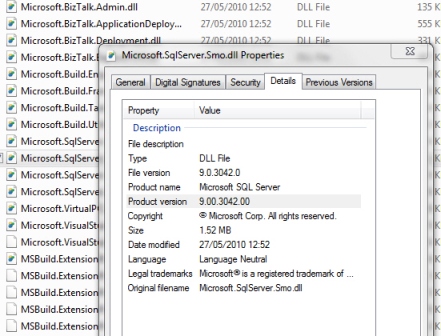 Figure: Keep these two versions consistent If you are not using the GAC, it is important to keep AssemblyVersion, AssemblyFileVersion and AssemblyInformationalVersionAttribute the same, otherwise it can lead to support and maintenance nightmares. By default these version values are defined in the AssemblyInfo file. In the following examples, the first line is the version of the assembly and the second line is the actual version display in file properties.
How do you get a setting from a configuration file? What do you do when you want to get a setting from a registry, or a database? Everyone faces these problems, and most people come up with their own solution. We used to have a few different standards, but when Microsoft released the Configuration Application Blocks, we have found that working to extend it and use it in all our projects saves us a lot of time! Use a local configuration file for machine and/or user specific settings (such as a connection string), and use a database for any shared values such as Tax Rates.
See how we configured this reset default settings functionality with the Configuration Block in the .NET Toolkit
In almost every application we have a user settings file to store the state of the application. We want to be able to reset the settings if anything goes wrong.
See how we configured this reset default settings functionality with the Configuration Block in the .NET Toolkit
There are 2 types of connection strings. The first contains only address type information without authorization secrets. These can use all of the simpler methods of storing configuration as none of this data is secret.
It is good to store program settings in an .xml file. But developers rarely worry about future schema changes and how they will inform the user it is an old schema.
What is wrong with this?
Both controls can represent XML hierarchical data and support Extensible Stylesheet Language (XSL) templates, which can be used to transform an XML file into a the correct format and structure. While TreeView can apply Styles more easily, provide special properties that simplify the customization of the appearance of elements based on their current state.
There are three types of settings files that we may need to use in .NET :
Windows Communication Foundation (WCF) extends .NET Framework to enable building secure, reliable & interoperable Web Services.
WCF demonstrated interoperability with using the Web Services Security (WSS) including UsernameToken over SSL, UsernameToken for X509 Certificate and X509 Mutual Certificate profiles.
Did you know if you are using DataSets throughout your application (not data readers) then you don't need to have any code about connection opening or closing.
Some say it is better to be explicit. However the bottom line is less code is less bugs.
Each class definition should live in its own file. This ensures it's easy to locate class definitions outside the Visual Studio IDE (e.g. SourceSafe, Windows Explorer)
EF Core provides a powerful way to interact with databases using .NET, but poor query optimization can lead to significant performance issues. Developers often fall into common pitfalls like inserting data in a loop, running excessive queries, or keeping track of too many entities. By following these best practices, you can improve performance and reduce database load.
Instead of images sitting all around the solution, we put all the images in the same folder.
per page
1 - 20 of 63 itemsper page
1 - 20 of 63 items